Address KCB Building,5th Floor,Enterprise Road
,Nairobi
Tel:0729946716
Work Hours
Monday to Friday: 8AM - 5PM
Saturday : 8AM - 2PM
Sunday & Public Holidays : Closed
Address KCB Building,5th Floor,Enterprise Road
,Nairobi
Tel:0729946716
Work Hours
Monday to Friday: 8AM - 5PM
Saturday : 8AM - 2PM
Sunday & Public Holidays : Closed
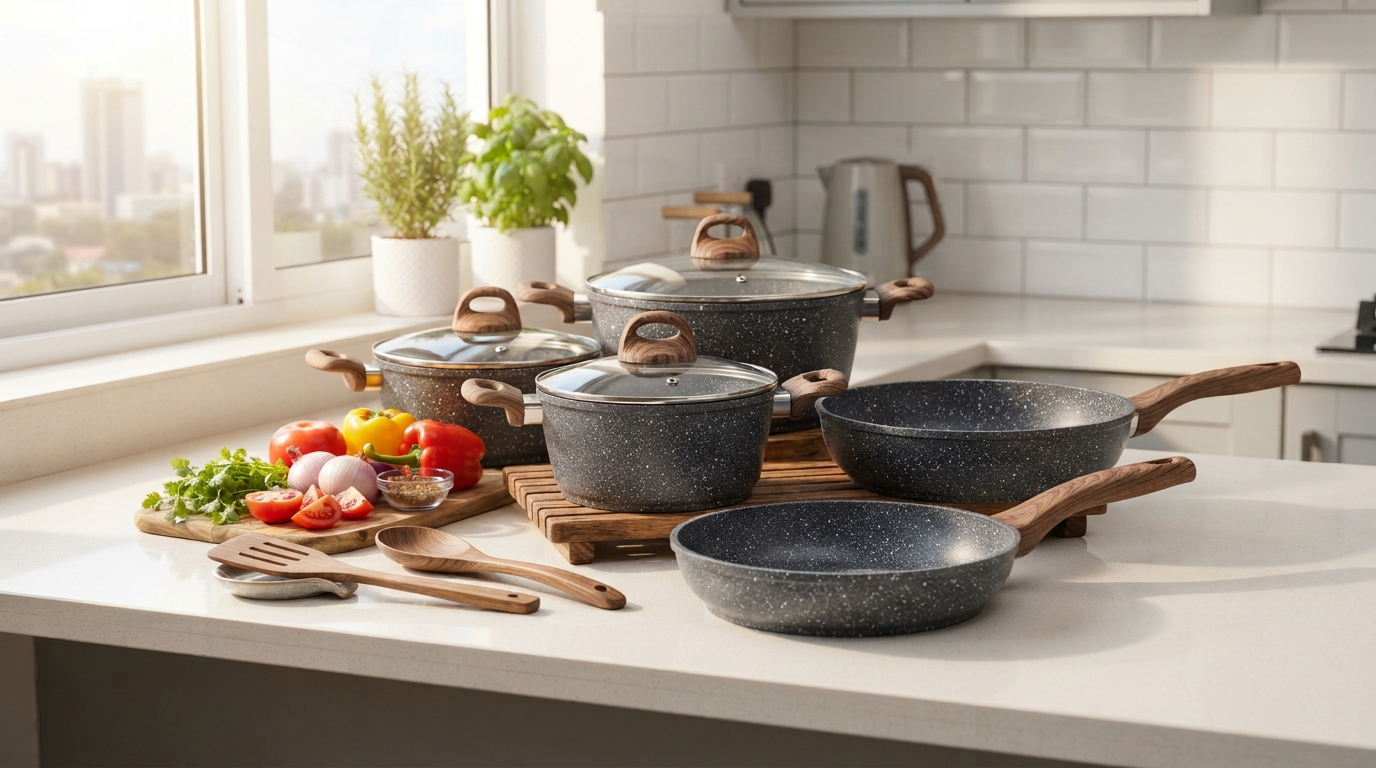
Upgrading your kitchen with non-stick cookware makes everyday cooking faster, healthier, and much easier to clean. Whether you are frying chapatis, simmering stews, or making morning eggs, the right pot prevents food from burning and cuts down on the amount of cooking oil you need.
However, with so many options on the market—from granite-coated sufurias to ceramic frying pans—picking a set that actually lasts requires knowing what to look for. Here is everything you need to consider before buying non-stick cookware for your Kenyan kitchen.
The coating is the most important part of your pan. Different materials offer different levels of durability, heat tolerance, and ease of cleaning.
| Coating Type | Best For | Heat Tolerance | Key Advantage |
|---|---|---|---|
| Granite / Marble-Coated | Everyday Kenyan meals, stews, and chapatis | Medium to Medium-High | Thick, scratch-resistant multi-layer finish |
| Ceramic | Quick frying, eggs, and health-conscious cooking | Medium to High | 100% free of synthetic chemicals (PTFE/PFOA) |
| Traditional PTFE (Teflon) | Delicate foods, pancakes, and omelettes | Low to Medium | Ultra-slick surface that requires minimal oil |
| Hard-Anodized Aluminum | Heavy daily use and browning meats | High | Twice as hard as stainless steel and warp-resistant |
Granite cookware is hugely popular in Kenya for good reason. Despite the name, it is not made of solid stone; it consists of a heavy aluminum core sprayed with a speckled, reinforced non-stick coating. It distributes heat evenly and resists minor scratches better than standard non-stick pans.
Ceramic pans feature a sleek, glossy finish derived from sand (silica). They are naturally free of synthetic chemicals and handle slightly higher temperatures than traditional non-stick coatings, though their slickness can wear down faster if overheated.
Modern PTFE coatings are safe when used properly and offer the most effortless food release. Just keep the flame on low to medium, as extreme heat can damage the coating over time.
When shopping for cookware, always verify that the packaging explicitly states PFOA-free, lead-free, and cadmium-free. Older non-stick manufacturing used PFOA, a chemical linked to health concerns. Reputable modern cookware brands have completely phased it out, ensuring your family’s meals stay safe and toxin-free.
Before falling in love with a cookware set, check the bottom of the pot to make sure it works with your kitchen setup:
A good non-stick pan should feel substantial in your hand.
If you are setting up a new home or overhauling old pots, a 7-piece to 12-piece cookware set offers the best value. A well-rounded set typically includes:
If you already have good stainless steel sufurias for boiling and heavy cooking, buying one or two standalone non-stick frying pans may be all you need.
Even the best non-stick cookware will peel if mistreated. Follow these habits to extend its lifespan:
1. Which is better between granite and ceramic non-stick cookware?
Granite-coated cookware is generally more durable for everyday Kenyan cooking, such as simmering stews and making chapatis, because its multi-layer reinforced surface resists scratches better. Ceramic cookware is ideal if you prefer a 100% synthetic-free coating for quick, low-to-medium heat frying like eggs and pancakes.
2. Can I cook ugali in a non-stick sufuria?
It is best to avoid cooking thick ugali in non-stick sufurias. Making ugali requires high heat and vigorous stirring with a heavy mwiko, which can scratch, overheat, and wear down the non-stick coating quickly. Use traditional heavy-gauge aluminum or stainless steel sufurias for ugali instead.
3. Is non-stick cookware safe for my family?
Yes, modern non-stick cookware is safe as long as it is labeled PFOA-free, lead-free, and cadmium-free. Always cook on low to medium heat and avoid using metal spoons to keep the coating intact.
4. Can I use non-stick pots on an induction cooker?
Only if the pot has a magnetic stainless steel base. Check the bottom of the cookware for an induction-ready coil symbol or test it with a fridge magnet—if the magnet sticks to the base, it will work on an induction hob.
5. How do I stop my non-stick pan from peeling?
Never preheat an empty non-stick pan on high flame, switch to wooden or silicone cooking utensils, avoid abrasive steel wire scrubbers, and always let the pan cool down completely before washing it with water.
Ready to transform your daily cooking experience? Browse our curated collection of durable, PFOA-free non-stick cookware sets, granite sufurias, and frying pans at SuperBox.co.ke. Enjoy wholesale-inspired prices, verified manufacturer quality, and fast 24–48 hour delivery in Nairobi and countrywide across Kenya.
